
Special Educational Needs: Change is Blowing in the Wind

Key Points
- The Government suggests a more inclusive SEND offering in mainstream schools by creating more tiers of support.
- Many of those who work in/have experience of the SEND sector fear this may dilute the support currently provided.
- Parents can prepare by building evidence, checking timelines, scrutinising plans, planning for mainstream first, and understanding challenge routes.
England’s SEND landscape is on the cusp of its biggest shift in a decade. Reports today point to a White Paper that could redraw how support is identified, delivered and enforced. Although we do not have the detail from Government, the objective is clear from their perspective. The Government has indicated its intentions to provide support for more children in the hope that quality support in the early years will obviate the need for this to continue for their entire childhood years. The ultimate goal appears to be to save money.
What may be coming
The headlines suggest a stronger, more consistent mainstream offer, with a national framework that clarifies who gets what support and when. It is suggested that schools would take a more central role in planning and evidencing provision day‑to‑day, while expert panels and national standards would sit behind the most specialist packages. Whilst this all sounds promising, it is imperative that schools are appropriately trained and supported to have this input; that there is transparency around the different tiers of support provided by way of Individual Support Plans (ILPs) and that expert panels are also suitably qualified to consider the individual child’s needs.
There is also talk of structured checks at key educational transitions, so that support is reviewed before children move phase. The current system provides for phase transfers [LD1.1] so that the individual child’s needs are considered and provided for at relevant times. Often in my experience, this doesn’t happen as and when it should. Will the new system be better?
The system today — in numbers
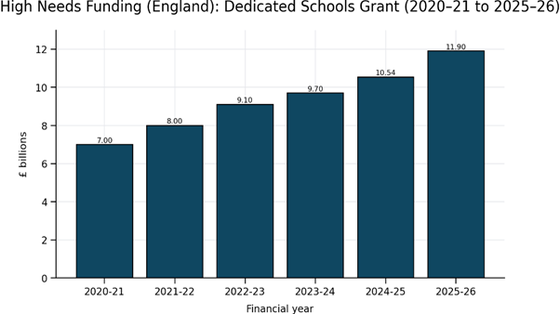
Even before reform, demand and spend have continued to climb. In reality this is the potential catalyst for change, particularly with so many councils pleading for financial support.
The official figures below put scale around the lived experience of families and schools, in terms of number of children in receipt of EHCPs and the spend by the Government, on behalf of the taxpayer.
EHCPs in England (January census, 2020–2025)
Source: Department for Education

High Needs funding (England), Dedicated Schools Grant
Source: Department for Education
What this could mean for parents
Expect earlier, clearer conversations in mainstream settings about what is ordinarily available and how it will be measured. Where a plan sits at school level, the quality of the written provision, and the evidence that it’s being delivered, will matter more than ever. If your child’s needs are complex, specialist packages should be defined against national standards. The test will be whether the proposed support is genuinely capable of meeting your child’s needs, not just whether it fits a local template.
Annual reviews will take on added weight at transition points. Practical preparation, current reports, progress data, and concrete examples of what has and hasn’t worked, will help you navigate those conversations with confidence.
Five practical steps (to start now)
- Build your evidence base. Keep assessments, provision details and outcomes up to date, so progress is visible and gaps are undeniable.
- Check your timelines. For Y5 and Y11 in particular, get annual reviews in the diary early and agree what success should look like in the next phase.
- Scrutinise the plan. Whether school‑led or statutory, insist on precise, measurable provision (who, what, how often, for how long) and clear outcomes.
- Plan for mainstream first. Expect reasonable adjustments and targeted interventions to be tested and recorded before escalation to more specialist routes.
- Know your routes. Rights of challenge and appeal are unlikely to disappear; understanding the process and timescales helps you act quickly and proportionately. It also prepares you to go into battle with authorities if required.
What to watch next
The detail in the White Paper will matter. The legal footing of any school‑led plan, the teeth behind national standards, and the transition arrangements from the current system will be key. Once proposals are published, we’ll translate the fine print into actions schools and families can take straight away.
If you’d value a calm, evidenced led view on where this leaves your child I am here to help. I will keep abreast of the changes, when they are formally announced, and consider the detail of the proposals.
Celia Whittuck
Celia is an education law senior associate who supports children, their parents and University students with the full breadth of legal issues across the education system.
- Senior Associate
- T: +44 (0)118 207 5528
- Email me

Posted by Celia Whittuck
The articles published on this website, current at the date of publication, are for reference purposes only. They do not constitute legal advice and should not be relied upon as such. Specific legal advice about your own circumstances should always be sought separately before taking any action.